
Rhinoplasty in Austin, TX
Your nose sits at the center of your face, so even a subtle irregularity can affect how confident you feel in photos, conversations, or simply when looking in the mirror. Rhinoplasty, commonly known as a nose job, is a surgical procedure that reshapes the external nose to improve its cosmetic appearance. Led by Dr. Daniel Slaughter, who has more than 25 years of rhinoplasty experience, our physicians focus on achieving natural-looking rhinoplasty results rather than an overdone appearance.
Quick Links
What Is Rhinoplasty?
Rhinoplasty is a surgical procedure that reshapes the external structure of the nose. The goal of rhinoplasty isn’t to create a dramatically different nose but rather one that looks naturally balanced with the rest of your facial features. The best nose is one that goes unnoticed—it enhances your overall appearance by allowing your eyes, smile, and other defining features to take center stage rather than drawing attention to itself.
Who Is a Good Candidate for Rhinoplasty?
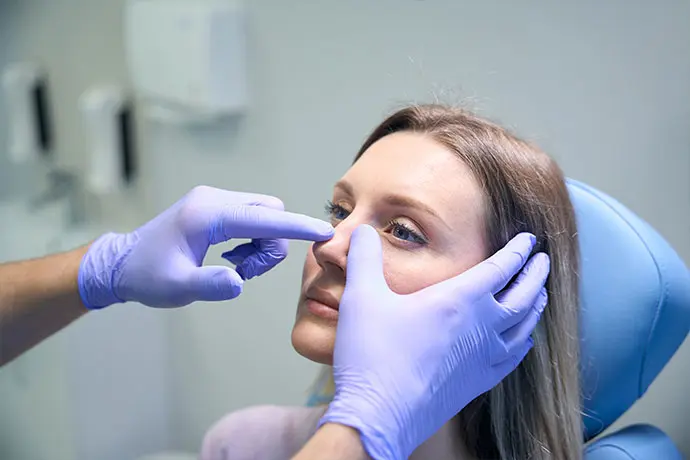
People who want to change the cosmetic appearance of their nose are typically good candidates for rhinoplasty.
Common concerns include:
- A nose that appears too large for the face
- An irregular or asymmetrical shape
- A nasal tip that’s too large or not well-defined
- A visible nasal hump
Benefits of Rhinoplasty
An aesthetically unbalanced nose can affect a person’s confidence, whether in personal relationships, the workplace, or everyday social interactions. Rhinoplasty can remove that psychological barrier, helping patients feel more at ease and less preoccupied with how their nose looks to others.
How to Prepare for Your Rhinoplasty Consultation
Before your procedure, you’ll have a detailed consultation with your physician, who will review the specific aesthetic changes recommended for your rhinoplasty. Many patients bring photos that represent the look they’re hoping to achieve. Your physician will walk you through the procedure in detail and answer any questions you have, so you know exactly what to expect on the day of surgery.
The Rhinoplasty Procedure
The rhinoplasty procedure takes place at our office in Austin, TX. Patients arrive about an hour before the procedure for preparation and then receive IV sedation so they don’t feel any pain during surgery. A small incision is made at the base of the nose, between the nostrils, to access the nasal structures.
The specifics vary from patient to patient, but the procedure typically involves reshaping the nasal bones to reduce a hump and correct any irregularities or asymmetry. The nasal tip may also be reshaped to reduce irregularities, prominence, or a bulbous appearance, creating a tip that is symmetrical with the nasal bones. Nasal projection, rotation, and overall balance are all addressed as part of the treatment plan.
The small incision is closed with dissolvable sutures, and a small external splint is applied. There is no packing inside the nose, so patients are able to breathe through their nose after the procedure. The procedure typically takes about an hour, and patients are able to leave the office about 30 minutes later with a friend or family member driving them home.
Can Rhinoplasty Also Fix Sinus Problems?
In many cases, yes. Internal sinus procedures can be performed at the same time as rhinoplasty to address both cosmetic and functional concerns during a single procedure. These may include:
If you’re dealing with both the appearance of your nose and how well you can breathe through it, this is worth discussing during your consultation.
Recovery After Rhinoplasty
Most patients tolerate rhinoplasty recovery well and may need pain medication for a couple of days. Some bruising around the eyes is common and typically resolves within two weeks. An external splint remains in place for about five days and is removed in our office by your doctor or physician assistant. The small incision between the nostrils requires antibiotic ointment for about two weeks and typically heals to become nearly imperceptible within three weeks. Most patients return to work within a couple of days and can resume aerobic exercise in about a week.
How Soon Will I See Results After Rhinoplasty?
The nose will be swollen, especially at the tip, for about two weeks. By four weeks, it is approximately 65% healed, although subtle improvements continue for up to a year.
Is Rhinoplasty Painful?
Our Sinus & Snoring Specialists patients are often surprised by how little pain is involved in rhinoplasty recovery. The day after surgery, most patients rate their pain between 0 and 4 on a scale of 0 to 10. Swelling tends to be a bigger factor in recovery than pain.
What Will My Scarring Look Like After Rhinoplasty?
Scarring is rarely a concern with rhinoplasty. Even when the open rhinoplasty technique is used, the only incision is made on the columella, the small strip of tissue between the nostrils. This incision is barely noticeable and fades significantly over time.
Risks of Rhinoplasty
As with any surgery, rhinoplasty carries the general risks of infection, reactions to anesthesia, and poor wound healing, although these are rare.
Risks specific to rhinoplasty include:
- Difficulty breathing through the nose
- Permanent numbness in or around the nose
- An uneven or asymmetrical appearance
- Pain, discoloration, or swelling that lasts longer than expected
- A perforated septum
- The need for revision surgery
The greatest risk associated with rhinoplasty is patient dissatisfaction with the cosmetic outcome, which is why it is important to choose a board-certified otolaryngologist with extensive rhinoplasty experience.
Schedule a Consultation
If you’re interested in learning more about rhinoplasty, contact our office at (512) 601-0303 to schedule a consultation. We proudly serve Austin and the surrounding areas of Texas.
Rhinoplasty in Austin, TX – FAQs
Is rhinoplasty painful?
Most rhinoplasty patients experience less pain than expected. On the day after surgery, patients typically rate their discomfort between 0 and 4 on a 10-point scale, and swelling tends to be more noticeable than actual pain.
Will rhinoplasty leave a visible scar?
Rhinoplasty rarely leaves a noticeable scar. Even when an open technique is used, the incision is placed on the columella, the small strip of skin between the nostrils, and it typically fades until it’s barely visible.
Where is the incision made during rhinoplasty?
During rhinoplasty, a small incision at the base of the nose, between the nostrils, on a strip of tissue called the columella. The incision is closed with dissolvable sutures and typically heals to be nearly imperceptible within about three weeks.
How long does it take to recover from rhinoplasty?
Most rhinoplasty patients can return to work within a couple of days and resume aerobic exercise in about a week. The external splint comes off around day five, and any bruising around the eyes usually clears within two weeks.
How soon will I see my final rhinoplasty results?
Swelling, especially at the tip of the nose, is common for about two weeks after rhinoplasty. By four weeks, the nose is roughly 65% healed, though subtle refinements continue to show for up to a year.
Can rhinoplasty also improve my breathing?
Yes. Rhinoplasty can be combined with internal sinus procedures such as balloon sinuplasty, septoplasty, or turbinate reduction to address breathing problems at the same time as cosmetic concerns.
What are the risks of rhinoplasty?
Rhinoplasty carries the general risks associated with any surgery, such as infection or a reaction to anesthesia, along with risks specific to nose surgery like breathing difficulty, numbness, asymmetry, or the need for revision surgery. These risks are uncommon, especially when the procedure is performed by an experienced, board-certified otolaryngology surgeon.
Who is a good candidate for rhinoplasty?
Good candidates for rhinoplasty are typically bothered by a specific aesthetic concern, such as a nose that appears too large, an irregular shape, a poorly defined tip, or a visible nasal hump. A consultation can help determine whether rhinoplasty is the right option for your goals.